The GRAVITATE H2020 (REFLECTIVE-7) project has started in June 2015,
see the project website.
The summary of the proposal reads:
Geometric Reconstruction And noVel semantIc reunificaTion of culturAl heriTage objEcts
The overall objectives of the GRAVITATE project are to create a set of software tools that will allow archaeologists and
curators to reconstruct shattered or broken cultural objects, to identify and re-unify parts of a cultural object that has been
separated across collections and to recognise associations between cultural artefacts that will allow new knowledge and
understanding of past societies to be inferred.
The project involves, as partners, a world-renowned museum, an archaeology
institute, and research partners working in the manipulation of 3-D objects, semantic analysis and ICT integration. The
project is driven by the needs of the archaeological institutes, exemplified by a pertinent use case, the Salamis collection
shared between Cyprus and the British Museum.
Expertise in 3-D scanning from previous project experience enables the
partners to embark on a programme of geometrical feature extraction and matching on the one hand, and semantic
annotation and matching on the other. The integration of these approaches into a single decision support platform, with a full
suite of visualisation tools will provide a unique resource for the cultural heritage research community.
We anticipate that the
insights to be gained from the use of these tools will lead to faster and more accurate reconstruction of cultural heritage
objects for study and exhibition, to greater opportunities for reunification of objects between collections and greater insights
into relationships between past societies which can be communicated as coherent narratives to the public through new
forms of virtual and tangible displays, involving the reconstructed objects themselves as well as 3-D printed objects and
digital visualisations.
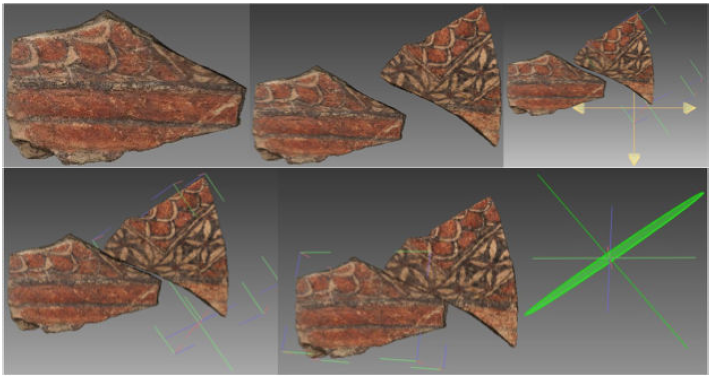
3 Year Postdoc Position Available
The Informatics Institute at the University of Amsterdam has a 3-year postdoc position available in the GRAVITATE project.
(For a suitable candidate, it may also be possible to turn this into a 4-year PhD position, please enquire.)
General Project Information
The goal of the H2020 project GRAVITATE is to investigate and employ digital methods in archeological and conservational research. Specifically, the intention is to use digital scans and digital metadata on objects to reassemble, reunite and reassociate broken and dispersed artifacts.
The partners in the project are in computer science (ICT Innovation in Southampton, UK; CNR/Imati in Genova, Italy; University of Amsteram, The Netherlands; Technion, Haifa, Israel) and in the field of application (British Museum, London, UK; Cyprus Institute, Lefkosia, Cyprus); and all have previous experience in computer-based cultural heritage projects.
Within GRAVITATE, the Informatics Institute of the University of Amsterdam (UvA) is hiring a postdoc for 3 years. Together with local principal researcher dr. Leo Dorst, the postdoc will be responsible mainly for the low-level geometric reassembly algorithms. UvA is to produce geometric data representations (and conversions between them) suitable for the various aspects of this reassembly task, and efficient algorithms to propose and verify possible matches. These will need to be combined with the objects' shape and metadata aspects investigated by other partners into a single hybrid search platform, deployed on a specific use case of the cultural heritage partners.
To give a flavor of the activities, UvA is involved in the following work packages (with number of months indicated):
- WP1 (0): Coordination and management (this is done by partner ITInnovation)
- WP2 (3): User requirement analysis and planning
- WP3 (24, leader): Geometric and semantic matching research agenda
- WP4 (12): Exploring the space of similarities: interactive and visual use experience
- WP5 (4): Analysis, design and development of GRAVITATE hybrid search platform
- WP6 (3): Use case preparation and pilot deployment
- WP7 (6): Dissemination and exploration
The project has already kicked off in June 2015.
Requirements:
Applicants must have a PhD involving 3D object representation and manipulation (or expect to have one in the Summer of 2015).
In addition, a successful candidate should have:
- good knowledge of computer graphics and/or computer vision
- strong math skills
- strong programming skills
- strong oral and written communication skills
- demonstrable publication record
The Intelligent System Lab at the University of Amsterdam
The successful candidate will be based in the Intelligent Systems Lab Amsterdam (ISLA) within the Informatics Institute at the University of Amsterdam. ISLA consists of 20 members of faculty, 20 post-doctoral researchers, and more than 50 PhD students. Members of the lab are actively pursuing a variety of research initiatives, including machine learning, decision-theoretic planning and learning, multiagent systems, natural language processing, information retrieval, and computer vision.
Some of the things we have to offer:
- competitive pay and excellent benefits
- extremely friendly working environment
- high-level of interaction
- location near the city center (15 minutes by bicycle) of one Europe's most beautiful and lively cities
- international environment (10+ nationalities in the group)
- access to high-end computing facilities (cluster with 4,000+ cores)
Since Amsterdam is a very international city where almost everybody speaks and understands English, candidates need not be afraid of the language barrier.
Further Information
Salary indication: € 2,476 to € 3,908 gross per month.
Informal inquiries can be made by email to Leo Dorst (l.dorst[[AT]]uva[[DOT]]nl) who is the local UvA-GRAVITATE project leader.
Job Application Procedure
Applications must be submitted via email to
application-science@uva.nl. To allow immediate processing of your application, please quote vacancy number 15-173 and the position you are applying for in the subject-line. Applications must include a detailed curriculum vitae, a motivation letter, and the names and contact addresses of two references from whom information about you may be obtained. All these should be grouped in one PDF attachment.
Applications are still being accepted till October 27, 2015.
No agencies please!