Input paper: Y. Feng, X. Wang, K. K. Wong, S. Wang, Y. Lu, M. Zhu, B. Wang, W. Chen, "PromptMagician: Interactive Prompt Engineering for Text-to-Image Creation", IEEE TVCG 30(1), January 2024, pp. 295–305.
Reference model: M. Worring, J. Zahálka, S. van den Elzen, M. T. Fischer, D. A. Keim, "Multimedia and Visual Analytics in the Agentic Era" (MMA) — Figure 1 (framework), Figure 2 (user interface), Figure 3 (human-AI teaming), Figure 4 (visual analytics agent).
The headline: this is the generation paper. MMA names it as such in its own impact section — "A system explicitly targeting the generation of images is PromptMagician which aids users in creating images fitting their preferences. This kind of system is an interesting component of future systems in which generation is one of the components in the overall system working alongside agents for analyze, query, and search." That sentence is both the compliment and the diagnosis, and the mapping below is largely an unpacking of it.
Three things make PromptMagician the odd one out among the five papers now mapped in this project, and all three are informative about the framework rather than about the paper.
First, the user is explicitly a novice. MMA's left-hand column is headed "Expert User". Feng et al. target "ordinary users who are interested in image creation but lack the expertise to use professional tools". The human is present, in control, and studied — but has no domain expertise to contribute. Everything the framework normally extracts from the expert has to be supplied to this user instead. That inverts what guidance is for.
Second, the data is created by the loop. In every other paper the collection is given and the analysis interrogates it. Here each iteration generates ~100 new images and retrieves a few hundred more, and the collection under analysis is rebuilt from scratch each turn. The analytics operates on its own output.
Third, almost nothing happens offline. The offline stage builds one CLIP index over DiffusionDB and freezes two models. Every step MMA would recognise as analysis — projection, clustering, keyword mining, rating — is recomputed per query, inside the interaction loop.
Figures (SVG):
| # | File | Follows |
|---|---|---|
| 1 | feng_fig1_offline_stage.svg |
offline stage, data and knowledge in / out |
| 2 | feng_fig2_online_stage.svg |
MMA Figure 1 — components and loops |
| 3 | feng_fig3_user_interface.svg |
MMA Figure 2 — the four UI pillars |
| 4 | feng_fig4_human_ai_teaming.svg |
MMA Figure 3 — action agents and coordinator |
| 5 | feng_fig5_va_agent_extension.svg |
MMA Figure 4 — a VA agent for prompt-based creation |
Figure conventions (shared across all five analyses in this project): every figure is generated from one parameterised template, so the five figures can be read side by side across papers. Zone colours follow the MMA paper itself — green for Foundation model-based AI, red for Human-AI Teaming, yellow for Human Understanding and the User Interface, blue for (un-)structured data. Status is encoded consistently: a white or solid box is realised in the paper, a yellow box partially realised, a dashed grey box absent, an orange border an annotation or a loop, and a purple box something the extension in section 5 proposes rather than something the paper contains.
Text-to-image models put an enormous creative space behind a text box, and the text box is the problem. Natural language is ambiguous, the mapping from words to pixels is opaque, and when the result disappoints the user cannot tell whether the prompt was wrong or the hyper-parameters were. Prior work went two ways: automate the prompt (AutoPrompt, Promptist, RePrompt, Opal), or publish general guidelines and "magic words". Feng et al. argue the first removes the human from a task that is irreducibly subjective, and the second is too generic for personal creative goals.
Their answer is a four-view visual analytics system built on frozen Stable Diffusion and frozen CLIP, driven by four requirements elicited from nine ordinary users over four months.
"[text] image" and a softmax over the two similarities; the resulting
distribution is brushable. Selected images open in a Local Exploration View with their prompts and
hyper-parameters, a BioFabric table of which keyword appears in which image's prompt, and a histogram of
the selected images' guidance scales. The user copies keywords into the prompt, narrows the scale range, and
resubmits.Evaluation: two usage scenarios, a user study with 12 participants against two baselines (A: retrieval without keyword recommendation, mimicking Lexica; B: generation with Promptist automatic prompting, no retrieval), and interviews with five Midjourney community experts. The system outperforms both baselines on every dimension of the Creativity Support Index; every participant said they would use it again.
The discussion names four open problems that turn out to map exactly onto MMA's empty boxes: semantic contamination (adding a keyword to fix one thing breaks another), when to stop, richer aesthetic evaluators, and multimodal fine-tuning interactions.
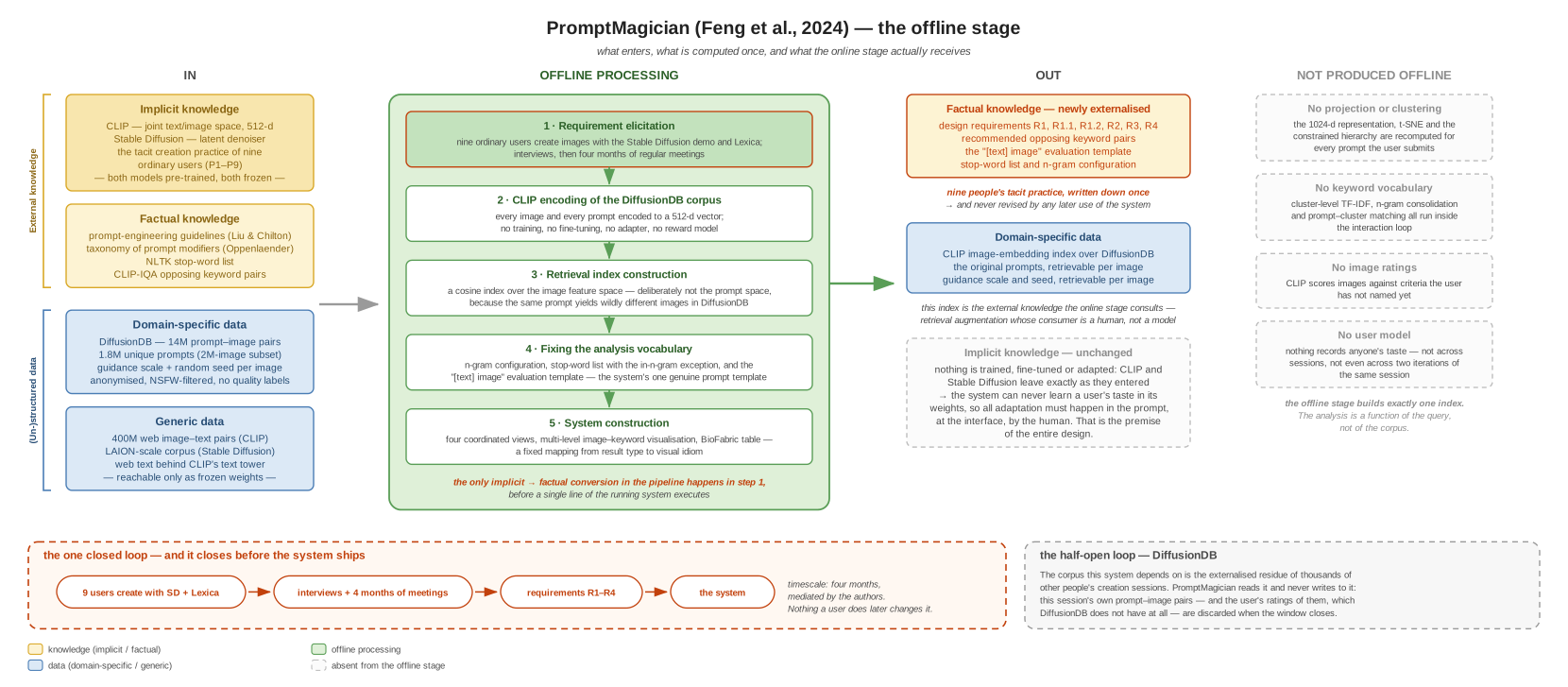
In. Generic data: the 400M web image–text pairs behind CLIP, the LAION-scale corpus behind Stable Diffusion, web text behind CLIP's text tower — none of it touched directly, reachable only through frozen weights. Domain-specific data: DiffusionDB, with per-image guidance scale and random seed; anonymised, NSFW-filtered, and carrying no quality or aesthetic labels. Factual knowledge: Liu & Chilton's finding that keywords matter more than phrasing, Oppenlaender's taxonomy of prompt modifiers, the NLTK stop-word list, and the CLIP-IQA opposing keyword pairs. Implicit knowledge: CLIP, Stable Diffusion, and the tacit creation practice of nine ordinary users.
Processing. Five steps, only one of which is a computation over the collection.
Requirement elicitation is the interesting one in MMA terms. Nine users create images with the public Stable Diffusion demo and with Lexica; the authors interview them, then meet regularly for four months. The output is R1–R4. This is the single implicit → factual knowledge conversion in the whole pipeline: tacit practice becomes an explicit, citable specification. Nothing in the running system does anything comparable.
CLIP-encoding and index construction is the only heavy computation: every DiffusionDB image and prompt becomes a 512-d vector, and a cosine index over the image vectors makes the corpus queryable cross-modally from text. No training, no fine-tuning, no adapters. The semantic gap is bridged by a frozen model rather than by learning anything about this domain.
Fixing the analysis vocabulary — n-gram configuration, stop-word list with the in-n-gram exception, and the
"[text] image" evaluation template — is where the system's one genuine prompt template gets written.
System construction fixes the mapping from result type to visual idiom.
Out. Implicit knowledge is unchanged: CLIP and Stable Diffusion leave exactly as they arrived. The consequence deserves stating plainly, because it is the premise of the whole design — the system can never learn a user's taste in its weights. All adaptation has to happen in the prompt, at the interface, by the human. That is why the interface has to be as good as it is.
Domain-specific data leaves as a searchable index plus retrievable prompts, guidance scales and seeds. This index is the external knowledge the online stage consults; in RAG terms it is the retrieval corpus, and the interesting wrinkle is that the retrieved context is never injected into a prompt by the system. It is rendered for a person, who reads it, judges it, and splices the chosen keywords in by hand. The augmentation step is the human.
Factual knowledge leaves enlarged by R1–R4, the criterion pairs, the evaluation template and the vocabulary configuration — small, fixed, and never growing again.
Deliberately not computed offline — and this is the structural point of figure 1 — the concatenated 1024-d representation, the t-SNE projection, the hierarchical clustering, the cluster-level TF-IDF, the n-gram consolidation, the prompt–cluster matching, and the image ratings. All of it runs fresh, per query, over the few hundred images retrieved for the current prompt. Where Gisolf et al. and Fischer et al. precompute a structure over a fixed collection and then let the user explore it, PromptMagician has no fixed collection to precompute over: the relevant subset is determined by a prompt that does not exist until the user types it. The analysis is a function of the query, not of the corpus. That is what makes the offline stage thin and the online stage unusually busy.
One loop closes offline, and only once: nine users' practice → design requirements → a system. There is no mechanism by which the system's own use feeds back into anything.
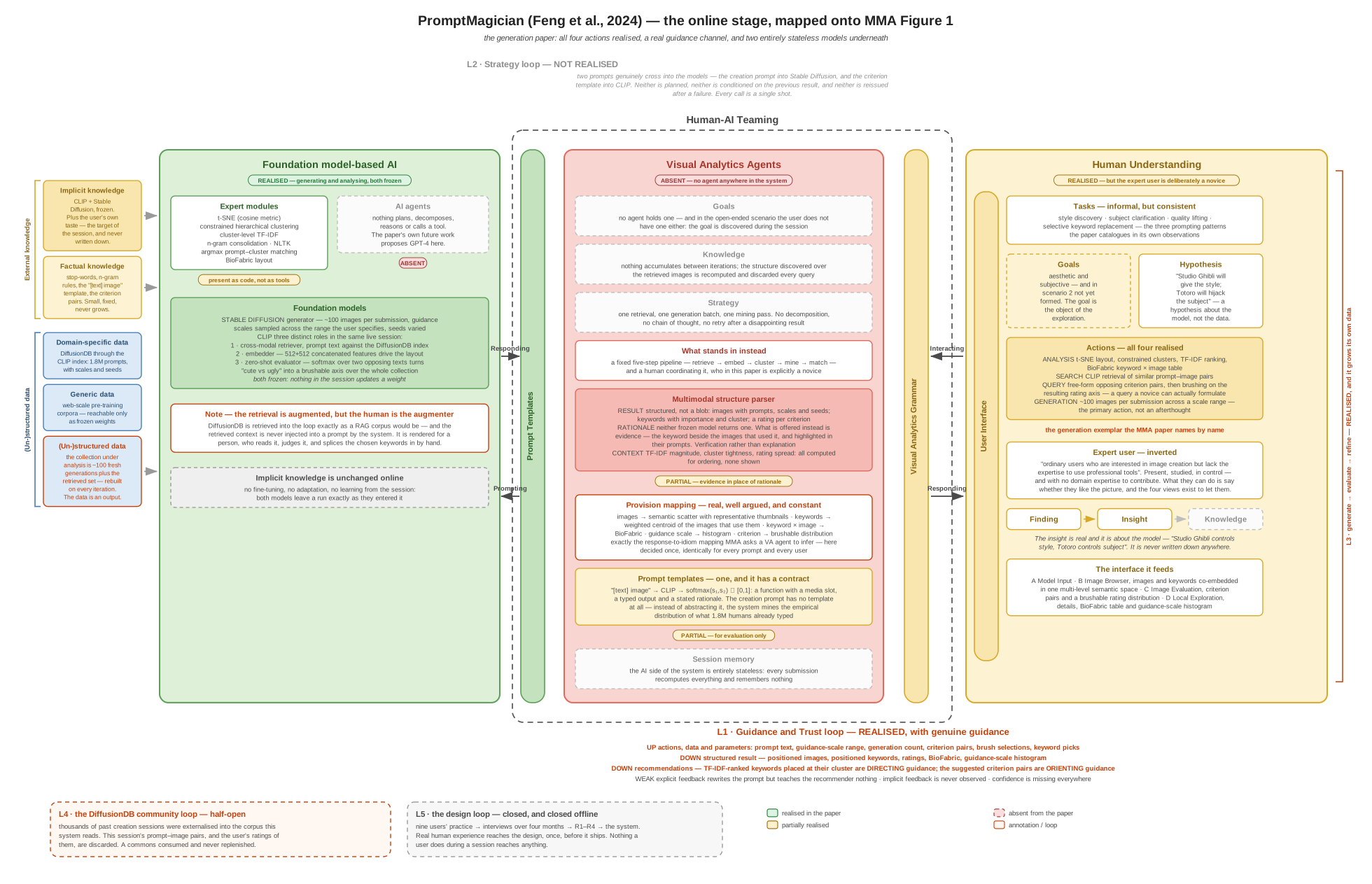
Expert user → ordinary user. The paper is explicit, and the inversion has consequences all the way down. MMA's expert brings domain knowledge the AI lacks; that is what justifies putting the human in ultimate control. Feng et al.'s user brings preference and nothing else. They cannot tell you what "Studio Ghibli" will do, they cannot judge whether a retrieved image is representative, and they will not recognise "Leonid Afremov" (P8 didn't). What they can do — reliably and better than any model — is say whether they like the picture. The system is therefore built to convert an enormous amount of model output into a form on which a non-expert can exercise exactly that one competence. Seen this way the four views are not a general analytics interface; they are a preference-elicitation instrument.
Goals are aesthetic, subjective, and frequently not yet formed. Scenario 2 starts from "a picture of a future world" and discovers, halfway through, that the goal involves cyberpunk robots in a futuristic city. MMA's coordinator agent decomposes a goal into subgoals; here the goal is itself the object of the exploration. That is a real gap in the framework's coverage and this paper exposes it.
Hypotheses are present and unusual in kind: they are hypotheses about the model, not about the data. "'Studio Ghibli' will supply the style; 'Totoro' will hijack the subject." Each is tested by generating. The analytic loop is closer to experimentation than to sensemaking.
Tasks are informal but consistent, and the paper's "notable observations" section effectively catalogues them: progressive detail addition, summarising suggestion ("summer afternoon" to control the hue of the sky), and selective keyword replacement ("carpet" → "pillow").
All four MMA actions are realised. Analysis: t-SNE layout, hierarchical clusters, TF-IDF keyword ranking, BioFabric keyword–image co-occurrence. Search: CLIP retrieval over DiffusionDB. Query: free-form criterion pairs plus brushing on the resulting rating axis — genuinely a query formulation step, and one a novice can perform. Generation: the primary action, first-class, and the reason MMA cites this paper.
Finding → insight → knowledge breaks at the last arrow. Findings are immediate ("this cluster is Totoro-style"). Insights are real and, notably, are insights about model behaviour rather than about a dataset ("'Studio Ghibli' controls style, 'Totoro' controls subject"). Knowledge is never externalised: nothing is annotated, named, kept, or carried forward. The session ends with one image, and the understanding the user built about how this model responds to words — which is arguably the more valuable product — evaporates.
The user interface is realised, and it is the paper's contribution. Four coordinated views, semantic zoom, brushing, click-to-highlight, and an unusually careful mapping from each result type to an idiom that a novice can read.
Foundation models are used live and in four roles across two models. Stable Diffusion generates. CLIP does three separate jobs in the same session: cross-modal retriever against the DiffusionDB index; embedder producing the concatenated features the layout is built on; and zero-shot evaluator, turning an arbitrary pair of English words into a brushable numeric axis over the whole image set. That third use is the most inventive thing in the system's plumbing — it lets a novice invent a criterion the designers never anticipated ("the strength of the animals in the images", which a participant tried and which worked) without any labelling, training or configuration. Both models are frozen throughout.
Expert modules are present as code, not as tools. t-SNE, constrained hierarchical clustering, cluster-level TF-IDF, NLTK filtering, argmax matching and BioFabric are all legitimate expert modules in MMA's sense — curated, sourced, explicit, with known behaviour. None is callable. They are welded into a fixed sequence that runs identically on every query, and nothing can choose to skip one, re-run one with different parameters, or substitute another.
AI agents are absent, and the paper says so in advance. Its future work proposes precisely an agent: use GPT-4 "to recommend prompt keywords for the image clusters or automatically revise user prompts according to the images of interest to the users."
Visual analytics agents: absent. Nothing holds a goal, decomposes intent, chooses a strategy, or revises after seeing a result. What stands in is a fixed five-step pipeline plus a human.
Visual analytics grammar: implicit but substantive. The provision mapping — images to a semantic scatter with representative thumbnails and translucent placeholders, keywords to the weighted centroid of the images that use them, keyword × image to BioFabric, guidance scale to a histogram, criterion to a brushable distribution — is exactly the response-to-idiom mapping MMA asks a VA agent to infer. It is correct, it is well argued in the paper, and it is a constant: identical for every prompt, every task and every user.
Prompt templates: one, and its absence is the paper's subject. The evaluation template "[text] image" is a
genuine MMA prompt template — a function with a media slot, a defined output type (a softmax score in [0,1]), and a
stated design rationale (two poles rather than one keyword, "to reduce the ambiguity that arises from using a
single keyword"). That is a contract. The creation prompt, the one that actually drives Stable Diffusion, has no
template, no slots and no contract, and the entire paper is a response to the trouble that causes.
The move Feng et al. make is worth stating precisely, because it is a genuine alternative to what MMA proposes. Rather than abstracting the prompt into a structured template, they substitute the empirical distribution of what 1.8M humans already typed. Instead of defining what a style slot is, the system shows you which strings other people put there and what came out. It is prompt engineering by ethnography rather than by specification — and it works, on the paper's own evidence, precisely because DiffusionDB is large enough for the empirical distribution to be informative. The cost is that nothing is ever named: the system cannot tell the user that "Studio Ghibli" is a style term and "Totoro" is a subject term, because it has no notion of either category. The user discovers this by generating twice. Section 5 argues that adding the abstraction back, on top of the corpus rather than instead of it, is the highest-leverage change available.
Strategy: absent. No chain of thought, no plan, no retry. One retrieval, one generation batch, one mining pass, and control returns to the human.
Multimodal structure parser: partially realised, and the substitute for rationale is interesting. Result is strong — a structured object, not a blob: images with prompts, guidance scales and seeds; keywords with importance scores and cluster assignments; ratings per criterion. Rationale is absent, because neither frozen model returns one; what the system offers instead is evidence — the keyword drawn beside the images that used it, BioFabric saying exactly which images those are, and the keyword highlighted inside its original prompt. This is verification rather than explanation, and for a generative model it may well be the better channel: the user sees the effect instead of reading a story about it. Context of results is the cheap gap — TF-IDF magnitude, distance to cluster centre, cluster tightness and rating spread are all computed and then discarded rather than shown.
| MMA component | In PromptMagician |
|---|---|
| Expert user | inverted — deliberately a novice; present, studied, in control |
| Goals | partial — subjective, and often discovered rather than specified |
| Hypothesis | realised — and about the model, not the data |
| Tasks | informal but consistent; catalogued in the paper's own observations |
| Actions: analysis / search / query | realised |
| Actions: generation | realised, and primary — the exemplar MMA cites |
| Finding → insight → knowledge | breaks at the last arrow; nothing is externalised |
| User interface | realised — four views, semantic zoom, BioFabric, brushing |
| Visual analytics agents | absent |
| Visual analytics grammar | implicit, but a rich and well-argued constant provision mapping |
| Prompt templates | one real template ("[text] image"), with a contract; none for creation |
| Strategy | absent |
| Multimodal structure parser | result strong; rationale replaced by evidence; context discarded |
| Foundation models | realised — SD generating, CLIP retrieving, embedding and evaluating |
| AI agents | absent, named as future work |
| Expert modules | present as code, hard-wired, not callable |
| Factual knowledge | small, fixed; the retrieval corpus does the work instead |
| Guidance | realised in the Outputs column, empty in the other three |
| Trust | partial — verification by example, no confidence anywhere |
| Session memory | absent — the AI side of the system is entirely stateless |
 Figure 3 — the interface against MMA Figure 2. Outputs is the strongest cell in any paper in this project:
one semantic space holding generated images, retrieved images and recommended keywords together, at three levels of
detail. Process is excellent on navigation and near-empty on progress — the one progress cue is the estimated
generation time, which participants valued because it let them trade batch size against waiting, and which is a
real progressive-visualisation affordance. Nothing shows progress toward the creative goal, how much of the
retrieved set has been seen, or how this iteration compares with the last; two iterations cannot even be placed
side by side. Knowledge is better than one would expect: BioFabric is a genuine structure view over the current
collection, and the generated/retrieved toggle is a genuine provenance encoding — mine versus the community's,
always distinguishable. What is missing is persistence. Trust substitutes verifiable examples for an absent
rationale, which is a defensible choice, and then omits confidence entirely.
Figure 3 — the interface against MMA Figure 2. Outputs is the strongest cell in any paper in this project:
one semantic space holding generated images, retrieved images and recommended keywords together, at three levels of
detail. Process is excellent on navigation and near-empty on progress — the one progress cue is the estimated
generation time, which participants valued because it let them trade batch size against waiting, and which is a
real progressive-visualisation affordance. Nothing shows progress toward the creative goal, how much of the
retrieved set has been seen, or how this iteration compares with the last; two iterations cannot even be placed
side by side. Knowledge is better than one would expect: BioFabric is a genuine structure view over the current
collection, and the generated/retrieved toggle is a genuine provenance encoding — mine versus the community's,
always distinguishable. What is missing is persistence. Trust substitutes verifiable examples for an absent
rationale, which is a defensible choice, and then omits confidence entirely.
The guidance row is the diagnostic one. It is populated in the Outputs column and empty in the other three — and each of the three empty cells corresponds to a problem the paper's own discussion section raises. No process guidance ↔ "users often struggle with when to terminate the fine-tuning process ... highlighting a need for guidance in the iterative process". No knowledge guidance ↔ nothing accumulates. No trust guidance ↔ "semantic contamination", the effect whereby an added keyword changes something the user did not intend, which the user must currently discover by generating.
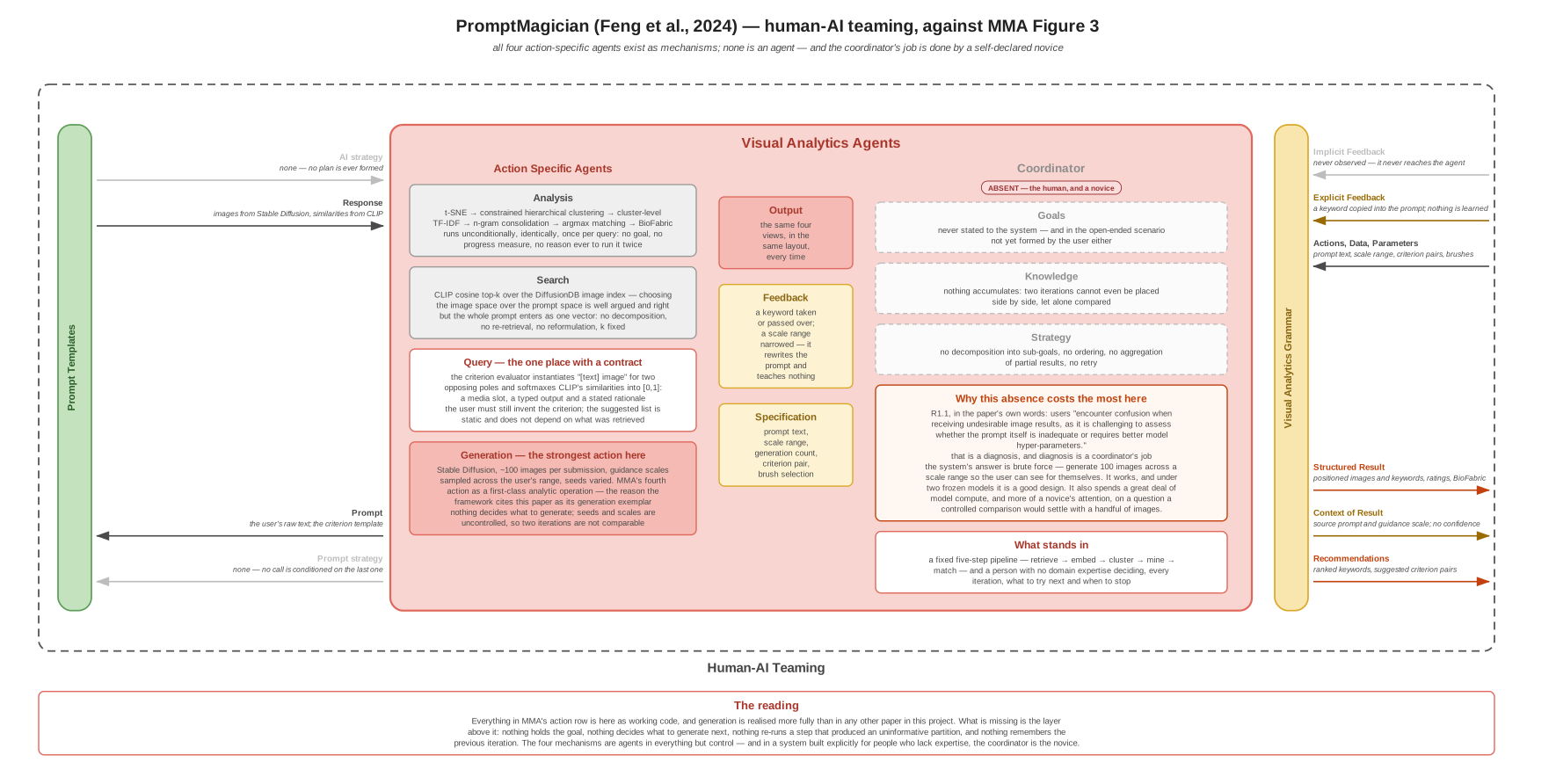 Figure 4 — human-AI teaming against MMA Figure 3. All four action-specific agents exist as mechanisms and none
is an agent: each fires once per query, in a fixed order, with no goal to satisfy, no progress measure, and no
reason to run a second time. Generation is the strongest; Query is the only one with a contract; Search is a single
undecomposed vector query; Analysis is unconditional.
Figure 4 — human-AI teaming against MMA Figure 3. All four action-specific agents exist as mechanisms and none
is an agent: each fires once per query, in a fixed order, with no goal to satisfy, no progress measure, and no
reason to run a second time. Generation is the strongest; Query is the only one with a contract; Search is a single
undecomposed vector query; Analysis is unconditional.
The coordinator is absent, and the paper supplies its own evidence for what that costs. R1.1 records that users "encounter confusion when receiving undesirable image results, as it is challenging to assess whether the prompt itself is inadequate or requires better model hyper-parameters." That is a diagnosis problem, and diagnosis is exactly a coordinator's job. The system's answer is brute force — generate 100 images across a scale range so the user can see for themselves. It works, and under the constraint of two frozen models it is a good design. But it spends a large amount of model compute and a larger amount of human attention on a question that a controlled comparison would answer with a handful of images.
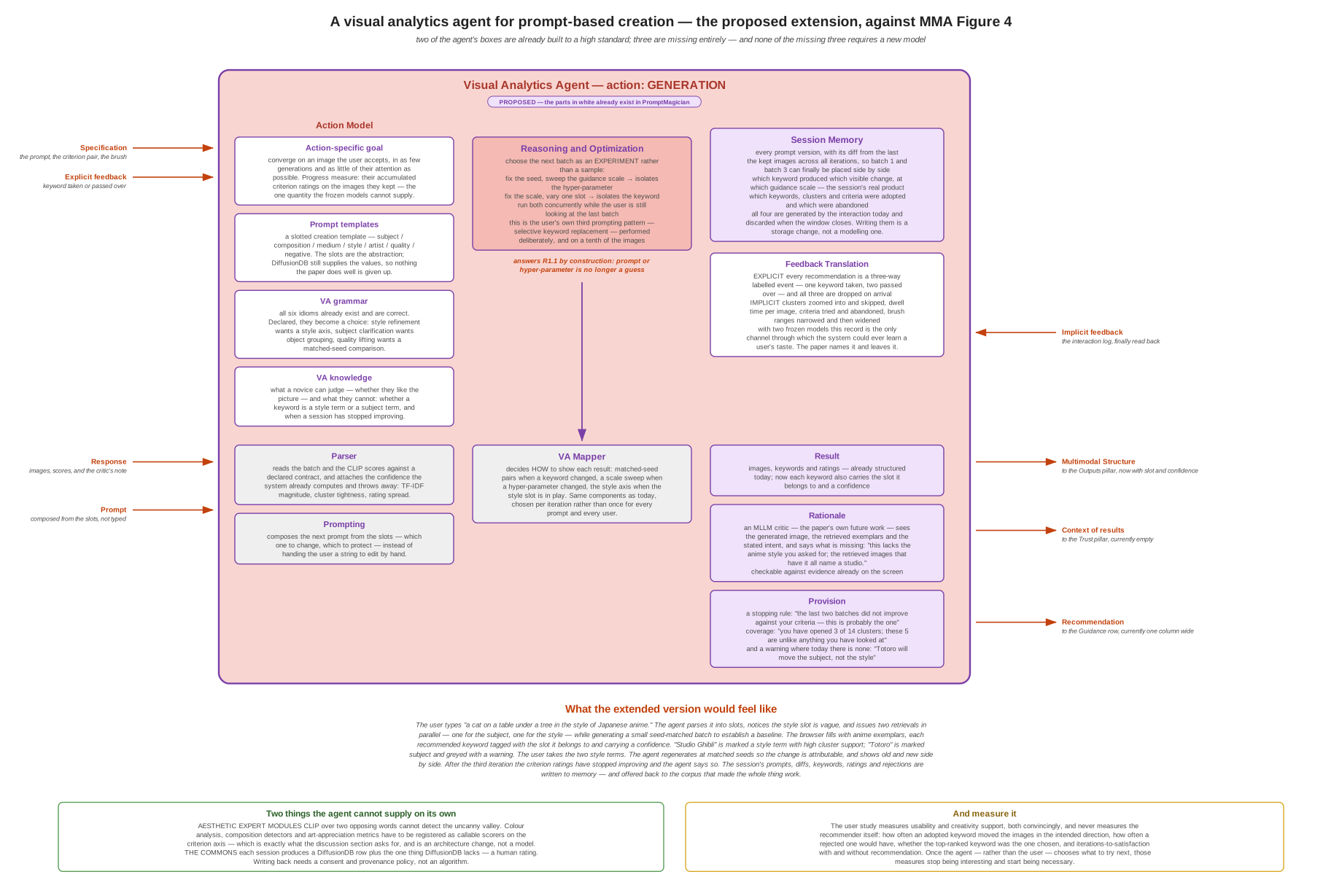 Figure 5 — a Generation VA agent. Instantiating MMA Figure 4 for this system produces an unusually encouraging
picture. Two of the agent's boxes are already built to a high standard: the provision mapping and the
structured result. Two are half-built: the prompt templates and the recommendation channel. Three are
missing entirely: the action goal and progress measure, the session memory, and the rationale. And the
missing three are cheap relative to the two that exist, because none of them requires a new model — a goal is a
stored target, a memory is a table, and a rationale is one MLLM call over material the system already has on
screen.
Figure 5 — a Generation VA agent. Instantiating MMA Figure 4 for this system produces an unusually encouraging
picture. Two of the agent's boxes are already built to a high standard: the provision mapping and the
structured result. Two are half-built: the prompt templates and the recommendation channel. Three are
missing entirely: the action goal and progress measure, the session memory, and the rationale. And the
missing three are cheap relative to the two that exist, because none of them requires a new model — a goal is a
stored target, a memory is a table, and a rationale is one MLLM call over material the system already has on
screen.
MMA's prescription for this paper is that generation should become "one of the components in the overall system working alongside agents for analyze, query, and search". The mechanisms for all four already exist. Below, roughly in descending order of value per unit of work.
Give the creation prompt a template — and let the corpus fill the slots. This is the single change with the widest downstream effect. Today the prompt is one undifferentiated string, and every problem the paper reports follows from that: keywords cannot be attributed to an effect, "Totoro" cannot be flagged as a subject term, semantic contamination cannot be prevented, and there is no way to change the style while holding the subject fixed. A slotted template — subject / composition / medium / style / artist / quality modifiers / negatives — makes each of those tractable. Crucially, this does not require abandoning what makes the paper work: the slots are the abstraction, and DiffusionDB still supplies the values. Slot assignment for mined keywords is itself learnable from the corpus — a keyword whose presence correlates with a change in CLIP's object embedding is a subject term; one that correlates with a change in style embedding at constant object embedding is a style term. Once slots exist, the recommender can say "these three keywords will change your style, this one will change your subject", which is precisely the warning the Trust guidance cell is missing.
Add a coordinator that diagnoses instead of flooding. R1.1's confusion — prompt or hyper-parameter? — is answerable. Generate a small controlled design rather than 100 uncontrolled samples: fix the seed and sweep the guidance scale to isolate the hyper-parameter effect; fix the scale and vary one slot to isolate the keyword effect. Present them as a comparison rather than a cloud. The user's own third observed pattern — selective keyword replacement — is exactly this experiment, performed by hand and one variable at a time. A coordinator can run it deliberately, in parallel, and in a tenth of the images.
Turn the four mechanisms into four agents. Each needs a goal and permission to run twice. The search agent should decompose the prompt — "a cat on a table under a tree in the style of Japanese anime" is a subject query and a style query, and retrieving for each separately would surface anime-style images that contain no cats, which is what the user actually wanted. The analysis agent should re-cluster when the current partition is uninformative (one cluster holding 80% of the retrieved images is a signal, and today nothing reads it). The query agent should propose criterion pairs derived from the retrieved set rather than from a static list — the axes along which these particular images vary are computable. The generation agent should choose the batch as an experiment. None of this needs a new model; it needs a loop around code that already exists.
Write a session memory. The AI side of PromptMagician is entirely stateless: each submission recomputes everything and forgets everything. Four things want storing — every prompt version with its diff from the last; the kept images across all iterations, so batch 1 and batch 3 can be compared side by side (today they cannot be); which keyword produced which visible change at which guidance scale; and which keywords, clusters and criteria were adopted or abandoned. The third of these is the session's real product and the one the user currently has to hold in their head. This is a storage change, not a modelling one.
Read the feedback back. Every keyword recommendation is a three-way labelled event — one adopted, two passed over — and every one is discarded on arrival. Implicit feedback is not even observed: which clusters were zoomed into and which skipped, dwell time per image, criteria tried and abandoned, brush ranges narrowed and then widened. The paper sees this: "these prompting patterns and user intents can be detected for adaptive recommendations to select and refine keywords." Because the models are frozen, this interaction record is the only channel through which the system could ever learn a user's taste. It is currently the one signal the system generates in abundance and consumes not at all.
Add an MLLM critic — the paper's own future work, in MMA's vocabulary. The paper proposes GPT-4 for keyword recommendation and prompt revision. In framework terms this is a verifier agent closing the loop that currently requires the human's eye: shown the generated image, the retrieved exemplars and the user's stated intent, it can say what is missing — "this lacks the anime style you asked for; the retrieved images that have it all name a studio." That is the rationale the structure parser has no source for today, and unlike a generic model explanation it is checkable against the evidence already on screen.
Surface the confidence you already compute. TF-IDF magnitude, distance to cluster centre, cluster tightness, the spread of CLIP ratings — all computed, all used for ordering, none shown as reliability. A keyword ranked first in a tight, well-separated cluster of forty images is a different recommendation from one ranked first in a diffuse cluster of four, and nothing in the interface distinguishes them. The numbers are already in memory.
Give guidance a stopping rule. "Users often struggle with when to terminate the fine-tuning process ... highlighting a need for guidance in the iterative process." A VA agent's action model is defined by MMA to include "a quantitative measure to assess progress towards the goal" — which is exactly what is needed here. The user's accumulated criterion ratings on the images they kept give a usable, revisable target: when the last two batches show no improvement against it, say so. Coverage guidance is equally cheap — "you have opened 3 of 14 clusters; these 5 are unlike anything you have looked at."
Turn the constant provision mapping into an inferred one. All six idioms are correct and all six are fixed. Declared as a grammar, they become choices: a style-refinement task wants a style-axis layout and keyword emphasis; a subject-clarification task wants object-level grouping; a quality-lifting task wants side-by-side comparison at matched seeds. Same components, chosen per task rather than once for all tasks.
Add real aesthetic expert modules. The discussion asks for this directly: CLIP alone cannot detect the uncanny valley, and the authors point to colour analysis and art-appreciation theory as richer evaluators. In MMA these are expert modules — curated, sourced, callable over MCP — and the criterion axis is already the right place to plug them in. The evaluation channel is currently a single mechanism (CLIP softmax over two words); making it a registry of scorers costs nothing architecturally and immediately admits composition detectors, palette analysers, face-quality models and domain-specific art metrics.
Close the DiffusionDB loop. The corpus that makes this system work is the externalised residue of other people's sessions. Each session run through PromptMagician produces exactly a DiffusionDB row — prompt, guidance scale, seed, image — plus the one thing DiffusionDB does not have: a human's rating of the result, and, better still, a record of which keyword was added and whether it helped. Writing back turns a consumed commons into a maintained one, and gives future retrieval a quality signal it currently lacks entirely.
And evaluate the guidance, not just the system. The user study measures usability and creativity support, both convincingly. What it does not measure is the recommender itself: how often an adopted keyword actually moved the images in the intended direction, how often a rejected one would have, how often the top-ranked keyword was the one chosen, how many iterations to satisfaction with and without recommendation. These are logged-in-passing quantities in the runs the authors already conducted, and an agentic version — where the system, not the user, chooses what to try — makes them necessary rather than merely interesting.
What the extended version would feel like. The user types "a cat on a table under a tree in the style of Japanese anime." The agent parses it into slots, notices the style slot is vague, and issues two retrievals in parallel — one for the subject, one for the style — while generating a small seed-matched batch to establish a baseline. The browser fills with anime-style exemplars, each recommended keyword tagged by the slot it belongs to and carrying a confidence. "Studio Ghibli" is marked as a style term with high cluster support; "Totoro" is marked subject and greyed with a warning. The user takes the two style terms. The agent regenerates at matched seeds so the change is attributable, and shows old and new side by side. After the third iteration the criterion ratings have stopped improving and the agent says so. The session's prompts, diffs, keywords, ratings and rejections are written to memory — and offered back to the corpus.