Rethinking mass transfer I & II: a unified semi-analytical framework for circular and eccentric binaries
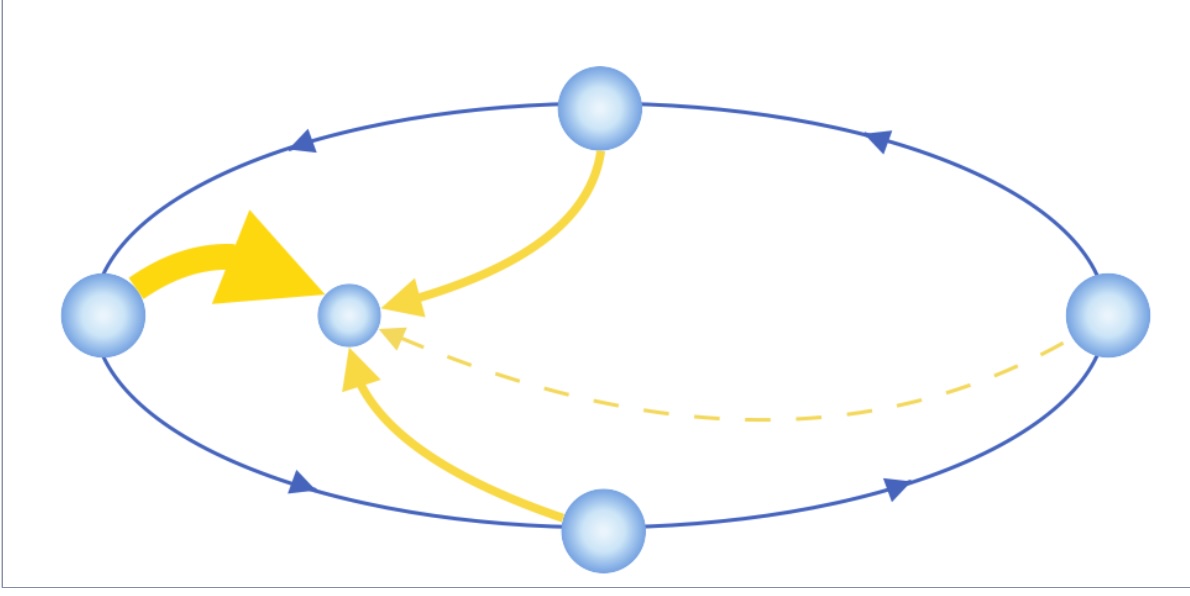
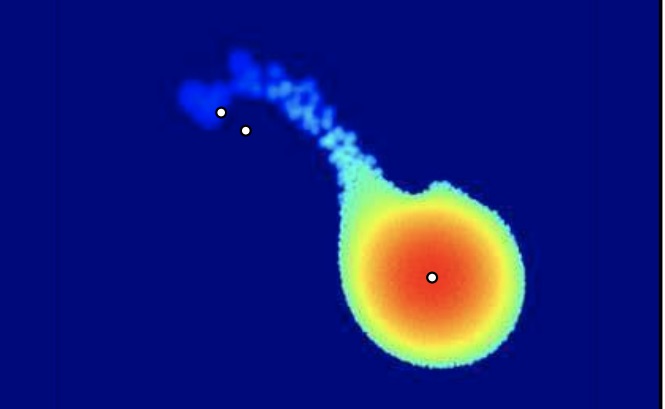
Adam’s first & second paper of the PhD are groundbreaking ones, as it changes the way we look at and model mass transfer between stars. So far, most models only consider circular orbits, while observations indicate that it also occurs in eccentric ones. Here we present a new framework for the orbital evolution of mass-transferring binaries, treating stars as extended bodies and accounting for the donor star`s spin. For the first time, there os a model that is applicable to both circular and eccentric orbits and accommodates conservative and non-conservative MT across a broad range of mass ratios and stellar spins. Our model predicts stronger orbital widening at a given mass ratio than previous models, and eccentricity pumping over a broader parameter space, matching the observed correlation between orbital periods and eccentricities observed in post mass transfer systems.
Hierarchical Triples vs. Globular Clusters: Binary black hole merger eccentricity distributions compete and evolve with redshift
Eccentricity is a powerful diagnostic to distinguish between different formation channels for gravitational wave sources. Both the cluster channels as the triple channel produces eccentric sources, but it will require as eccentricity distribution and the detection of a large number of eccentric mergers to differentiate between the channels. Here we study those distributions.
We find that the globular cluster channel dominates the overall rate, but when focusing on mergers with detectable eccentricity in next-generation detectors, we find that hierarchical triples dominate the eccentric merger rate at 0≤z≤4, challenging the common view that such systems primarily form in dense environments. We show that, regardless of cluster and stellar evolution uncertainties, hierarchical triples contribute at least 30 per cent of eccentric mergers across a large redshifts.
Black hole-black hole mergers with and without an electromagnetic counterpart: A model for stable tertiary mass transfer in hierarchical triple systems
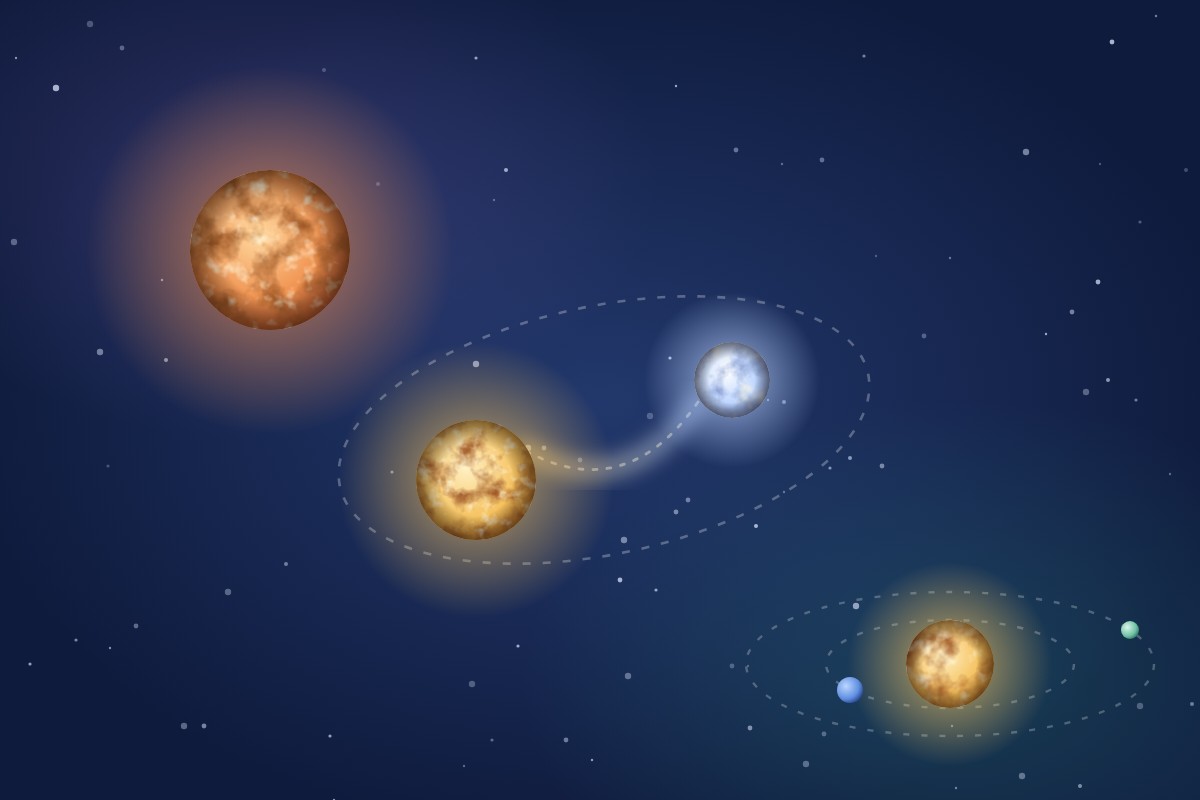
Tertiary mass transfer, where the outer star of a triple donates mass to an inner binary, is more common than once understood. This made Floris dive into the problem and develope the most detailed model to date to describe tertiary mass transfer. We also released this model as a public python package on Zenodo and github.
Floris applied his model to triples with an inner binary black hole formed through chemically homogeneous evolution.
Our results indicate that the mass transfer phase predominantly leads to orbital shrinkage of the inner binary and evolution towards non-zero eccentricities. We predict a high formation efficiency of GW mergers with short delay times and a local merger rate around 1 per Gpc cubed per yr. Systems that enter the LISA and aLIGO frequency band while still accreting gas from the tertiary star, could produce a strong electromagnetic (EM) counterpart to the GW source and maintain high eccentricities.